
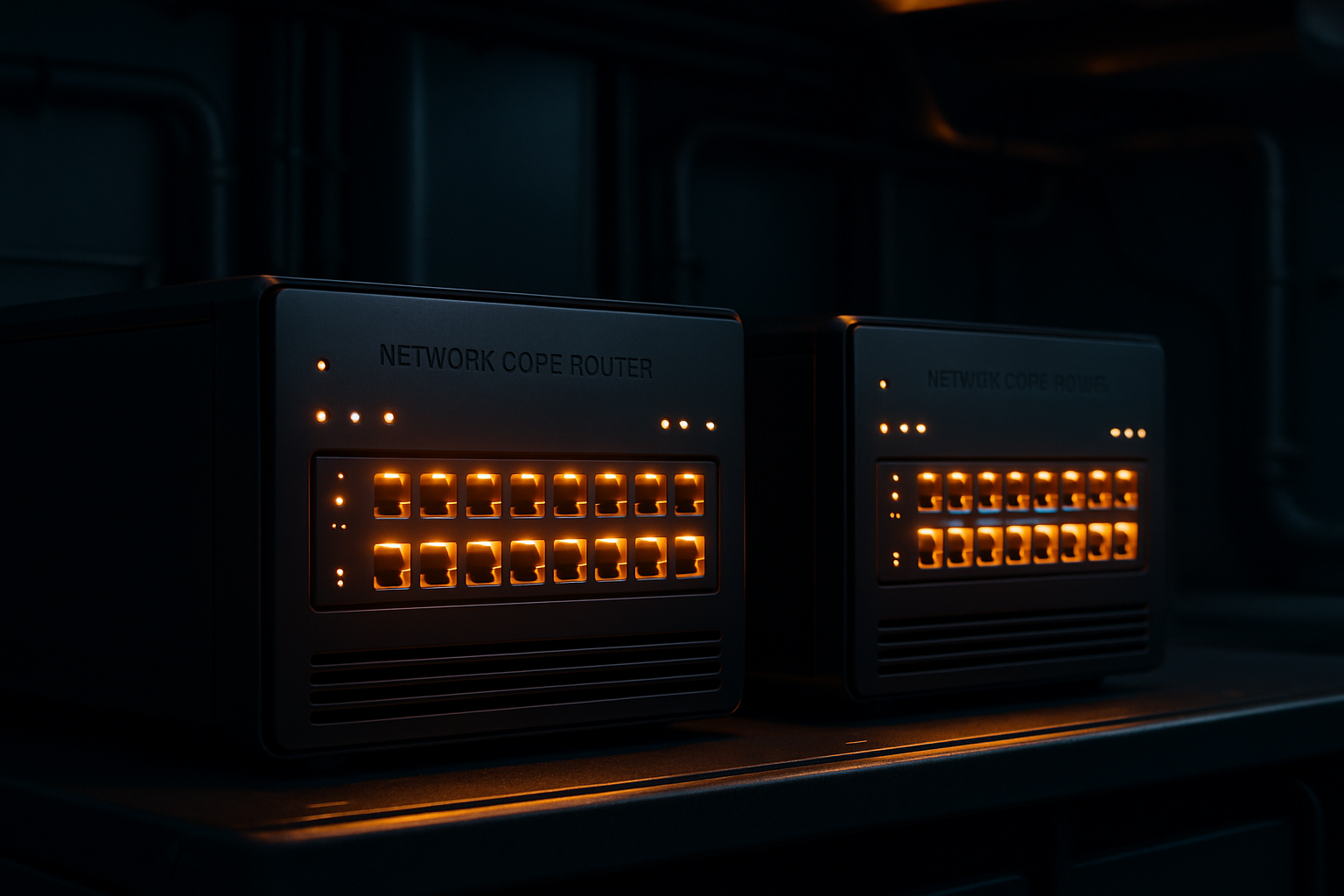
Bonding protects you when a link fails. But what protects you when the router fails? At sea, where there is no spare hardware ashore and no technician a phone call away, the core itself has to be redundant.
Two cores, one identity
A high-availability pair runs two core routers configured as one. If the active unit fails, the standby takes over the same addresses and sessions — the ship’s network stays up. Combine that with SpeedFusion bonding across all the satellite links, and you have removed both failure modes: a dead link is absorbed by the bond, and a dead router is covered by its twin.
Designed to survive, and to grow
This is why serious maritime deployments run HA pairs of aggregation-class routers — and why upgrading the platform (say, from EPX to Balance 5000 EC) keeps the same proven HA model in place. You add capacity without adding risk. The redundancy that kept the ship online at 2 Gbps keeps it online at 30.
Uptime, stability, simplicity, lower cost — on a vessel, redundancy is how you buy all four at once.
If your disaster-recovery plan includes the word “failover,” you’re doing it wrong.
SpeedFusion internet bonding means increased performance, more uptime, and no failover — because the session was already riding every link.
Own your network. Peplink hardware is bought once and it lasts — it keeps bonding and routing with or without an active warranty or the cloud. No forced subscriptions, no required licenses.
Learn the fundamentals at connectivity101.com.
Leave a Reply