
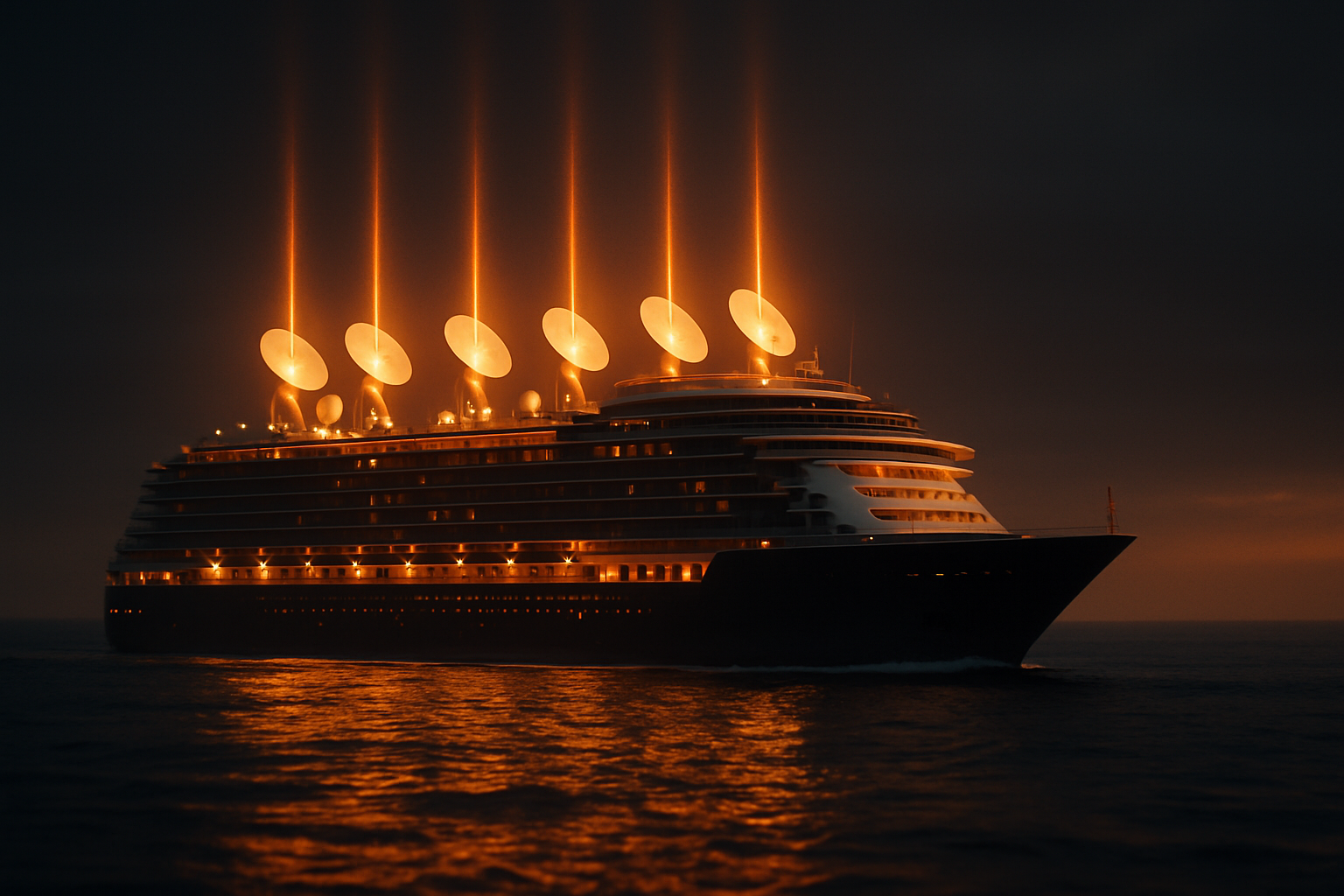
Cruise ships are among the most demanding connectivity environments on the planet: thousands of guests expecting the internet they have at home — streaming, video calls, social — in the middle of the ocean, on a platform that never stops moving. Traditional VSAT was expensive, slow, and could not scale.
The architecture
West Networks designed and deployed the Starlink-based architecture for a leading global cruise line — widely regarded as the fastest internet on any cruise ship. Twelve to twenty Starlink terminals, mounted port and starboard, are presented to a redundant pair of core routers via VLAN-as-WAN trunking. SpeedFusion bonds every terminal into one high-speed tunnel with intelligent load balancing and instant failover.
When a dish loses signal to the ship’s motion or a satellite handoff, the remaining links absorb the traffic instantly. Passengers never notice. The network simply works.
The 2025 upgrade
As demand grew, the core was upgraded from the Peplink EPX to a high-availability pair of Balance 5000 EC routers — unlocking 30+ Gbps of SpeedFusion bonding capacity and years of headroom as per-terminal throughput rises. The proven HA redundancy model stayed exactly the same.
- Zero-downtime failover across 12–20 bonded terminals.
- Consistent speed for thousands of guests and crew, daily.
- A core that scales with the fleet instead of being redesigned.
If your disaster-recovery plan includes the word “failover,” you’re doing it wrong.
SpeedFusion internet bonding means increased performance, more uptime, and no failover — because the session was already riding every link.
Own your network. Peplink hardware is bought once and it lasts — it keeps bonding and routing with or without an active warranty or the cloud. No forced subscriptions, no required licenses.
Learn the fundamentals at connectivity101.com.
Leave a Reply